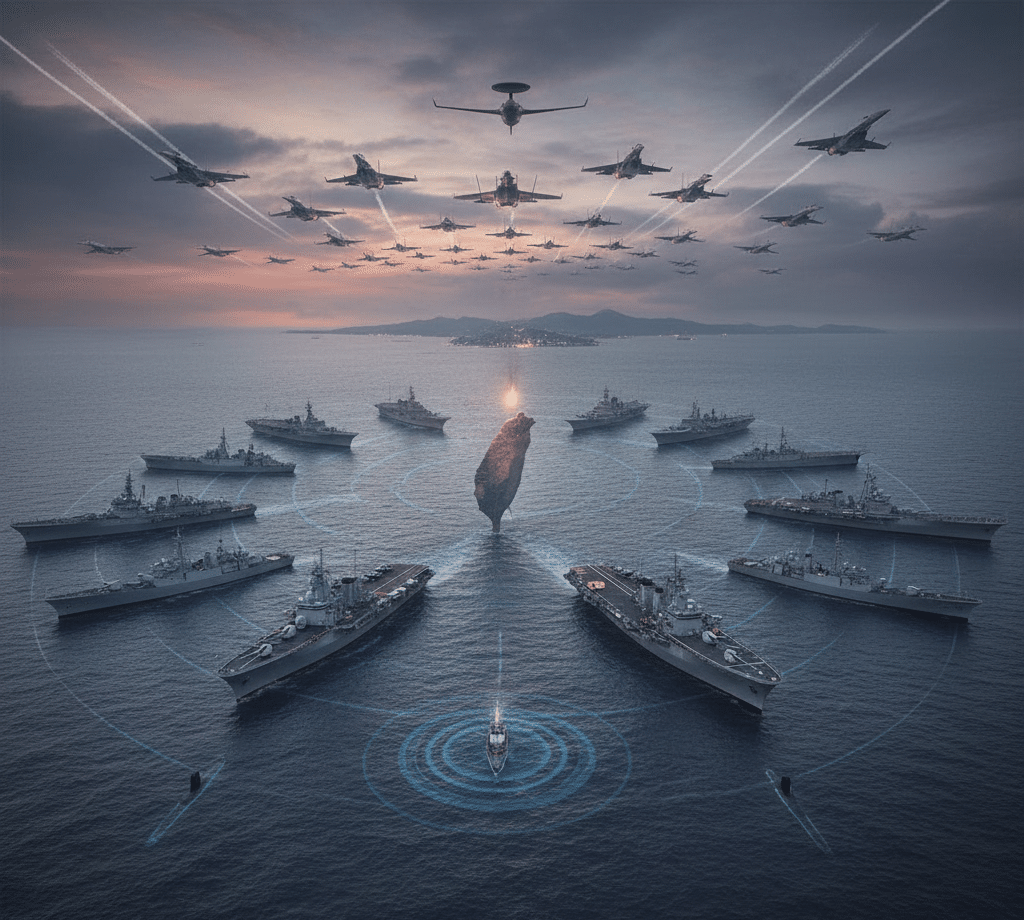
The large-scale military exercises conducted by the People’s Liberation Army (PLA) around Taiwan in late 2025 underscore Beijing’s deepening reliance on “coercive signaling” as a primary instrument for cross-strait management. While these maneuvers stopped short of kinetic conflict, their unprecedented geographic reach and multi-domain integration represent a sophisticated effort to refine joint operational capabilities while systematically gauging regional responses.
The strategic weight of these exercises extends beyond the tactical. By imposing administrative and economic friction—forcing flight reruns, disrupting shipping schedules, and altering risk premiums for insurers—Beijing has demonstrated how military activity translates into systemic pressure. As these “high-intensity rehearsals” become normalized, they redefine the parameters of risk, access, and regional security throughout the Indo-Pacific.
I. Operational Evolution: Beyond Traditional Maneuvers
1. Joint Operational Stress Tests
The 2025 drills were characterized by simultaneous operations across multiple axes, integrating naval, air, rocket, and cyber elements.
Distributed Pressure: Unlike previous exercises focused on single focal points, this multi-directional approach forces Taiwan’s defense architecture to respond to “omni-directional” stimuli, straining command-and-control (C2) coherence.
Organizational Learning: Analysts view these drills as stress tests for jointness. Coordinating logistics, real-time intelligence sharing, and theater-level command reveal operational friction points that remain hidden in scripted exercises. This “learning-by-doing” approach is essential for the PLA’s long-term goal of achieving seamless joint combat readiness.
2. Tactical Signaling and Strategic Flexibility
By maintaining a posture of “perpetual readiness” near Taiwan’s borders without crossing into open hostilities, Beijing achieves strategic ambiguity. This allows the central leadership to demonstrate resolve and military dominance while preserving diplomatic off-ramps, effectively shifting the burden of escalation onto Taipei and its partners.
II. Shifting the Security Baseline: The Danger of Normalization
A critical consequence of these exercises is the re-calibration of the regional status quo.
Warning Time Erosion: Maneuvers that once triggered international alerts are increasingly categorized as routine “noise.” This erosion of the security baseline complicates early-warning assessments, making it harder to distinguish between an exercise and the onset of actual mobilization.
Margin for Error: As the boundary between “training” and “crisis” blurs, the margin for operational error narrows, significantly increasing the risk of miscalculation during periods of high political sensitivity.
III. Societal Resilience and Administrative Attrition
1. The Cost of Administrative Readiness
Sustained military pressure functions as a form of administrative attrition. Taiwan’s government agencies—from transportation and economic affairs to defense—must maintain an elevated state of alert, diverting resources and intellectual capital toward crisis management. The “secondary effects,” such as insurer re-assessments of shipping routes, act as a subtle but persistent tax on Taiwan’s trade-dependent economy.
2. Communication Fatigue vs. Resilience
There is a looming risk of “alert fatigue” among the general public. As warnings become frequent, public sensitivity may decline, potentially weakening societal responsiveness during a genuine emergency. Maintaining institutional credibility and consistent, calm messaging is paramount to sustaining domestic resilience.
IV. Strategic Forecast (2026–2030): Managing Persistent Tension
In the medium term, we project a transition from “episodic exercises” to “sustained grey-zone presence.”
The Encirclement Standard: The 2025 model of multi-axis encirclement will likely become the baseline for future drills, with increased integration of autonomous systems (UAVs/USVs) to maintain pressure at a lower cost.
Incremental Encroachment: Expect a gradual tightening of the operational space around Taiwan’s key ports and maritime chokepoints, using “safety zones” and “exclusion areas” as administrative tools to challenge Taiwan’s effective jurisdiction.
Regional Posture Adjustments: The persistent density of military assets in the Taiwan Strait will likely lead to more permanent shifts in the forward deployments of Japan and the United States, creating a “crowded theater” where the potential for unintended tactical encounters is at its highest.
V. Policy Recommendations
For Regional Stakeholders: Prioritize the establishment of robust, tactical-level communication protocols to prevent unintended incidents in shared maritime and air spaces.
For Taiwan: Enhance the integration of civil-military response capacities. Strengthening the “absorptive capacity” of logistics and infrastructure against short-term disruptions is crucial to neutralizing the economic spillover of grey-zone activities.
For the International Community: Utilize multilateral forums to advocate for greater transparency in military exercises near sensitive global trade arteries. Sustained international attention serves as a critical check against the unilateral re-writing of maritime norms.
Disclaimer: This assessment is based on open-source intelligence and strategic modeling. It is intended to support informed policy dialogue and does not represent the official position of any government entity.