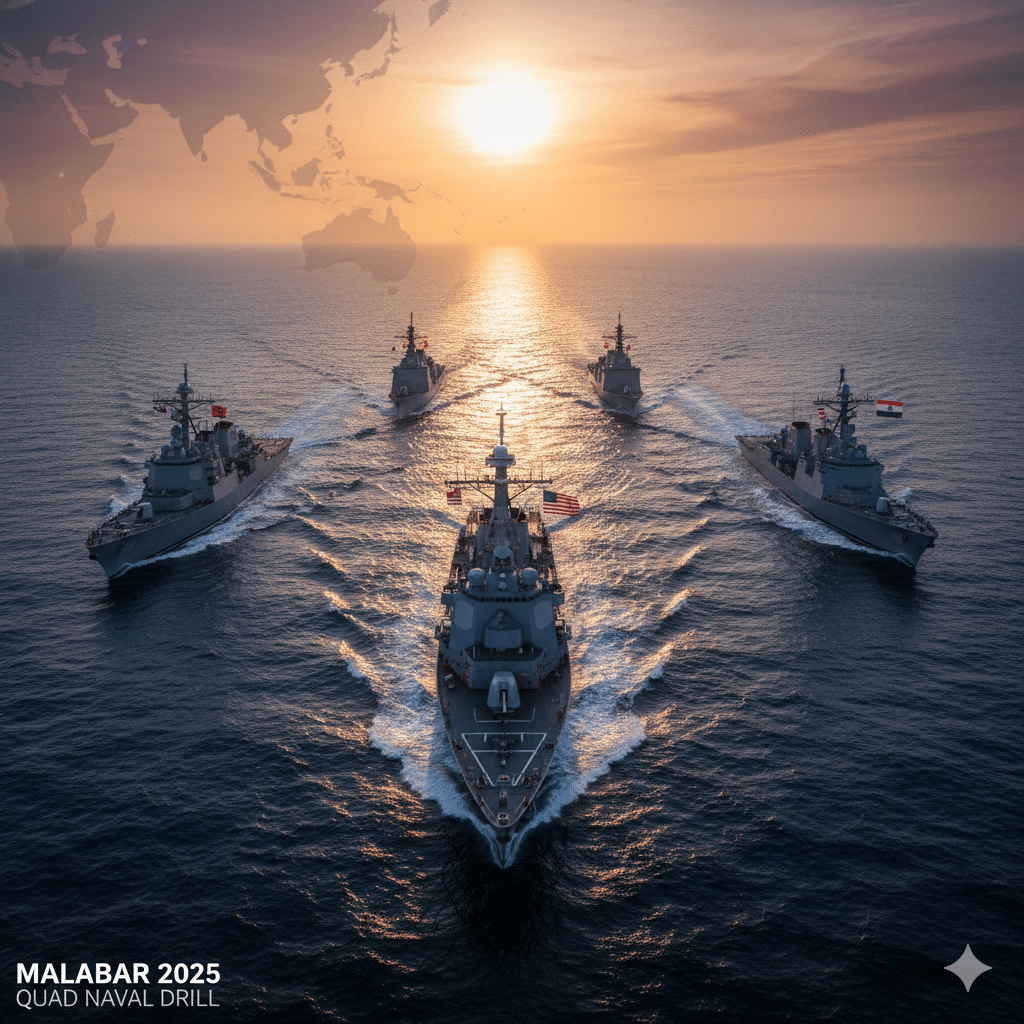
The headline confirming Australia’s participation in Exercise Malabar 2025 signifies a critical juncture in the evolution of the Quadrilateral Security Dialogue (Quad). This commentary argues that Malabar is transitioning the Quad from a consultative diplomatic platform into a substantive, operational security anchor for the Indo-Pacific’s democratic powers. Australia’s integral role provides essential geostrategic depth and completes the naval architecture necessary to effectively uphold the Rules-Based International Order (RBIO) across both the Indian Ocean and the Pacific. The successful integration and normalization of this high-end naval exercise serves as a powerful deterrent and is key to shaping the region’s strategic equilibrium in the coming decade.
I. The Strategic Gravity of Malabar’s Institutionalization
Malabar’s progression—from a limited bilateral drill to a permanent quadrilateral mechanism—is a direct response to the escalating strategic complexity in the Indo-Pacific. The 2025 iteration, featuring all four Quad members (the US, Japan, India, and Australia), reflects a determined effort toward institutionalization of security cooperation, moving beyond ad hoc arrangements.
Interoperability as a Strategic Asset: The core function of Malabar is to achieve deep interoperability (e.g., in Anti-Submarine Warfare (ASW), Maritime Interdiction Operations (MIO), and advanced air-sea coordination). This level of integration transforms the four navies into a cohesive, multi-domain force, thereby multiplying their collective power. This enhanced C4ISR (Command, Control, Communications, Computers, Intelligence, Surveillance, and Reconnaissance) capability is, fundamentally, a form of soft deterrence, signaling high military coordination to potential regional challengers.
Normalizing the Counterbalance: By consistently holding complex, high-visibility exercises, the Quad is normalizing the presence of a collective security force dedicated to preserving freedom of navigation and overflight. This continuous presence solidifies the Quad’s role as the security pillar of the Free and Open Indo-Pacific (FOIP) concept.
II. Australia’s Crucial Role: Geostrategic Depth and the Western Anchor
Australia’s permanent integration is arguably the most decisive factor in Malabar’s maturation, providing both geographical completeness and specialized operational capacity.
Bridging the Oceans: Australia provides the crucial geostrategic link between the Indian Ocean Region (IOR) and the South Pacific. Its inclusion extends the Quad’s operational footprint across the entire Indo-Pacific littoral, enabling a unified, two-ocean response capability. This is vital for collective security operations ranging from humanitarian assistance to maritime security patrols.
Future Force Projection: The Royal Australian Navy’s (RAN) expertise in high-end naval warfare, coupled with its commitment to acquiring nuclear-powered submarines under the AUKUS framework, represents a significant long-term boost to the Quad’s collective force structure. This commitment elevates Malabar beyond current capabilities and into the future of sophisticated naval deterrence.
III. Geopolitical Challenges and Future Trajectories
While the unified front displayed at Malabar is a success, the strategic implications demand careful diplomatic management to prevent miscalculation.
The Perception of Containment: The expanding scope of Malabar inevitably raises the perception, particularly in Beijing, of a military containment strategy. For the Quad to sustain its diplomatic narrative—that its focus is on shared values and cooperation, not hostility—it must continue to leverage its non-military initiatives (e.g., vaccine partnership, infrastructure quality standards) to balance its security function.
Defining the “Quad Plus” Security Scope: A long-term challenge is defining the extent of the Quad’s security outreach. Should Malabar remain exclusive to the four core nations, or should it evolve into a “Quad Plus” security mechanism by integrating partners like Vietnam, South Korea, or France? While inclusion would broaden the base for the RBIO, maintaining the current compact structure ensures decision-making agility and operational focus.
Conclusion
Exercise Malabar 2025 confirms that the Quad has entered a new phase of operational maturity and strategic coherence. Australia’s permanent seat at the table transforms the exercise from a series of bilateral drills into a single, cohesive security framework that spans the Indo-Pacific.
Moving forward, the success of the Quad will hinge on its ability to sustain high-level operational excellence demonstrated in Malabar, while simultaneously managing the geopolitical tensions its cohesion creates. The continued institutionalization of this naval partnership is not merely about deterrence; it is about establishing a durable, cooperative mechanism for collective security—the essential foundation for a peaceful and prosperous Indo-Pacific.
Policy Recommendation: Quad nations should establish a permanent, year-round Quad Maritime Domain Awareness Fusion Centre (Q-MDFC), leveraging the intelligence integration achieved during Malabar, to ensure continuous, shared monitoring of the Indo-Pacific’s strategic chokepoints.