Physical Address
304 North Cardinal St.
Dorchester Center, MA 02124
Physical Address
304 North Cardinal St.
Dorchester Center, MA 02124

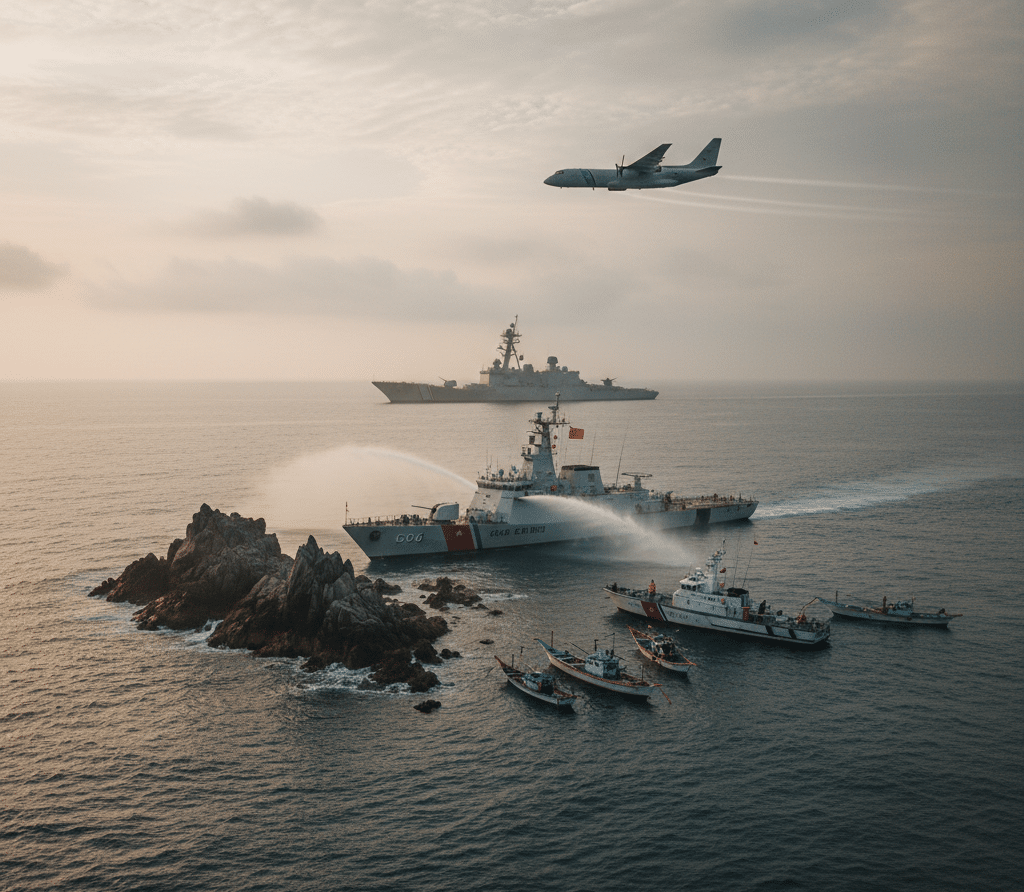
The confirmed joint military and coast guard patrols conducted by China around the Scarborough Shoal (Bajo de Masinloc) in late November 2025 mark a critical and aggressive pivot in Beijing’s South China Sea strategy.
This public action signifies a shift from relying primarily on “Gray Zone” tactics by the China Coast Guard (CCG) and maritime militia to the direct and normalized involvement of the People’s Liberation Army (PLA) in sovereignty disputes. This move is a severe demonstration of force against the Philippines, dramatically elevating the risk of accidental conflict in the area, and posing an immediate challenge to the credibility and limits of the U.S.-Philippines Mutual Defense Treaty (MDT).
The nature of this joint patrol suggests that Beijing is consolidating control over the Scarborough Shoal area, viewing it as a militarily dominated zone. The primary strategic intentions are two-fold:
By integrating PLA Navy vessels with CCG patrols, China is moving beyond mere quasi-military harassment. This joint presence aims to establish a new status quo where the PLA’s involvement is routine. This effectively semi-militarizes the immediate vicinity of the Shoal, asserting control through overt national military power rather than ambiguous law enforcement.
Scarborough Shoal lies within the Philippines’ Exclusive Economic Zone (EEZ) and is a critical fishing and resource gateway. The direct deployment of the PLA is a calculated effort to test the boundaries of what constitutes an “armed attack” under the MDT. Beijing seeks to exert sufficient pressure to deter Philippine resupply or access efforts while staying just below the threshold that would automatically trigger a definitive U.S. military response, thereby gradually eroding the MDT’s deterrent value.
The persistent, close-range maneuvers between heavily armed PLA/CCG ships and smaller Philippine vessels (Coast Guard, resupply boats) significantly amplify the potential for miscalculation or collision. Given the PLA’s direct participation, any incident—whether accidental or intentional—has a much higher probability of rapidly escalating to a kinetic engagement than previous CCG-only confrontations.
The credibility of the U.S. commitment is directly on the line. Failure by the U.S. to provide a robust and timely response to attacks on Philippine assets in the area could severely damage allied confidence across the Indo-Pacific. Conversely, active U.S. military involvement would transform the Shoal into a potential flashpoint for direct Sino-American confrontation.
China’s unilateral military escalation sends a strong message to ASEAN: Beijing prioritizes unilateral, force-backed actions over multilateral consensus. This further compromises the perceived effectiveness and binding nature of the ongoing negotiations for a South China Sea Code of Conduct.
We forecast a sustained period of heightened tension and irreversible strategic shifts in the South China Sea:
| Forecast Area | Trend and Specific Prediction | Strategic Implications |
| China’s Control | De Facto Exclusion: China will progressively enforce a de facto exclusion zone around the Shoal, potentially deploying non-combat platforms (e.g., permanent scientific buoys, patrol stations) to solidify its continuous presence and control. | Philippine fishermen and resupply efforts will be functionally barred from the Shoal, resulting in a loss of effective sovereignty for Manila. |
| U.S. Alliance Response | Rotation and Joint Presence: The U.S. will likely increase the frequency and visibility of joint maritime and air patrols with the Philippines and potentially other allies (e.g., Japan, Australia) near the area, but likely remain outside the 12-nautical-mile contested zone to manage escalation. | Deterrence by Presence will be tested. This will lead to complex, high-stakes maneuvering, risking close encounters between major naval powers. |
| PLA Capability | Targeting Philippine Sovereignty: The PLA will use these patrols to gather advanced Intelligence, Surveillance, and Reconnaissance (ISR) data on Philippine Coast Guard doctrine and vessel capabilities, tailoring future Gray Zone tactics for maximum effect and minimizing the risk of MDT activation. | China’s actions will become more precise and difficult for the Philippines to counter legally or militarily, forcing Manila to choose between capitulation or confrontation. |
To mitigate the escalating risks at the Scarborough Shoal, ANSPI recommends the following actions:
Disclaimer: This analysis is based on publicly available information and expert assessments. The views expressed herein do not necessarily reflect the official policies of any government or organization.