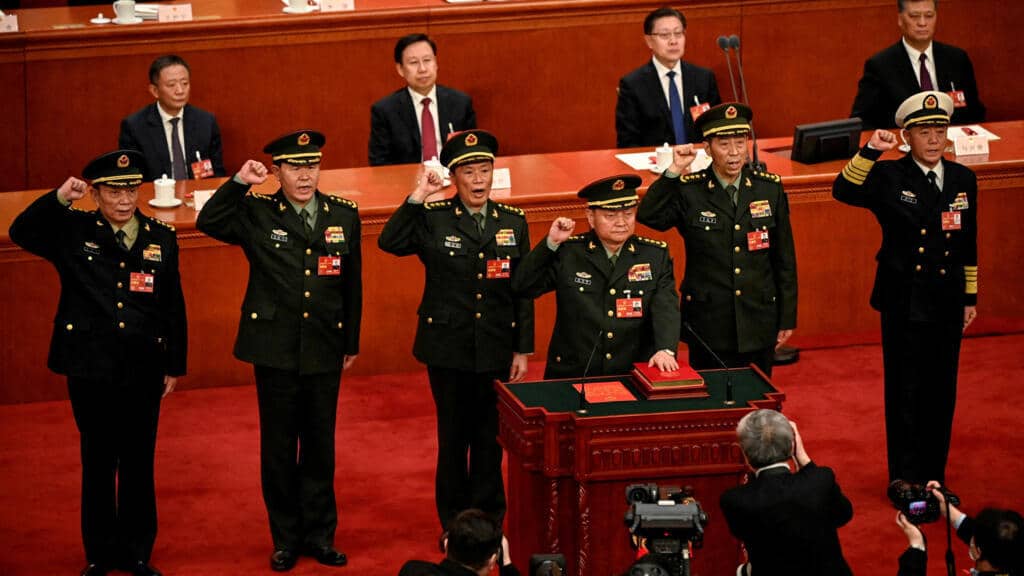
Recent reports, including those from CNN regarding internal investigations within the Central Military Commission (CMC) that may touch upon Vice Chairman Zhang Youxia, suggest a profound and high-stakes power struggle within Beijing’s political core. As one of the few high-ranking People’s Liberation Army (PLA) generals with combat experience and a long-standing ally of Xi Jinping, any perceived rift between Zhang and Xi becomes a critical variable for assessing China’s internal political stability and the trajectory of its military modernization.
This report analyzes the context of this potential “military purge,” the underlying logic of power balancing, and its profound implications for cross-strait stability and the PLA’s operational effectiveness.
I. Background: Escalating Military Purges and the Fall of Technocrats
Since 2023, the PLA has witnessed an unprecedented series of purges targeting high-ranking officials within the Rocket Force and the military-industrial complex, notably including former Defense Minister Li Shangfu. These actions reflect Xi Jinping’s deep anxieties regarding systemic corruption and the unwavering demand for “absolute loyalty.”
The Corruption-Readiness Paradox: Despite massive budgetary injections, pervasive corruption within the PLA has reportedly compromised the reliability of critical weapon systems, including advanced missile and nuclear capabilities. Xi’s consolidation of power aims to eradicate these weaknesses.
Zhang Youxia’s Pivotal Role: As a “princeling” with deep familial ties to Xi Jinping, Zhang Youxia has long been considered Xi’s indispensable “stabilizer” within the military. However, recent investigations into the Equipment Development Department—a department Zhang once commanded—have raised speculation about whether Xi is systematically eroding Zhang’s influence, or if Zhang himself is now under scrutiny.
II. Strategic Maneuvers: Power Balancing vs. Absolute Consolidation?
Analysis of the current military dynamics presents two main schools of thought among defense analysts:
The “Absolute Control” Thesis: This perspective argues that Xi Jinping is relentlessly dismantling all residual factionalism within the military, irrespective of personal loyalties. In this framework, no figure is “untouchable,” as Xi seeks singular, unchallenged authority over the PLA, crucial for his long-term strategic objectives, including Taiwan.
The “Defensive Counterbalance” Thesis: This view suggests that Zhang Youxia’s stature and deep connections within the PLA’s ground forces could pose a potential future challenge. Xi’s actions, therefore, might be a preemptive measure to prevent the formation of any alternative power center, using ongoing investigations to maintain a state of perpetual vigilance and mutual suspicion among generals. This constant scrutiny ensures that ultimate loyalty remains directed solely to Xi.
III. Strategic Forecast: The Next 12–24 Months (2026–2028)
Soft Landing or Public Scrutiny? We predict that Zhang Youxia is more likely to experience a “soft landing,” possibly retiring due to “health reasons” or “age.” A public dismissal or prosecution would signal an unprecedented level of instability within the CCP’s top echelons, potentially revealing deeper political fissures that Xi aims to suppress.
Cross-Strait Strategy Deterrence: The ongoing high-level instability and investigations are expected to foster a climate of extreme caution among PLA commanders. This “risk aversion” will likely lead to a short-term slowdown or more conservative approach to large-scale military actions, particularly around Taiwan, as officers prioritize avoiding mistakes over demonstrating initiative.
Reshaping the Officer Corps: As “combat-experienced” generals potentially face marginalization, Xi Jinping is likely to promote younger, more technocratic officers whose careers are entirely dependent on his patronage. While this enhances loyalty, it could, in the short term, undermine the PLA’s actual operational command capabilities and institutional memory.
IV. Policy Recommendations
Enhanced Intelligence Analysis: Western and regional intelligence agencies must intensify monitoring of mid-level PLA officers. High-level purges often indicate shifts in loyalty and potential vulnerabilities within the broader military command structure.
Assessing Unpredictability Risks: A stronger, yet more insular, decision-making circle under Xi increases the risk of unpredictable and potentially aggressive external actions, driven by internal political pressures. International actors must prepare for a more opaque and potentially volatile Chinese foreign policy.
Maintaining Communication Channels: Despite internal turmoil, maintaining military hotlines and diplomatic channels is paramount. This prevents miscalculations stemming from internal power struggles from inadvertently escalating regional conflicts.
Disclaimer: This report is based on publicly available media reports and geopolitical modeling. It does not represent any specific official stance.