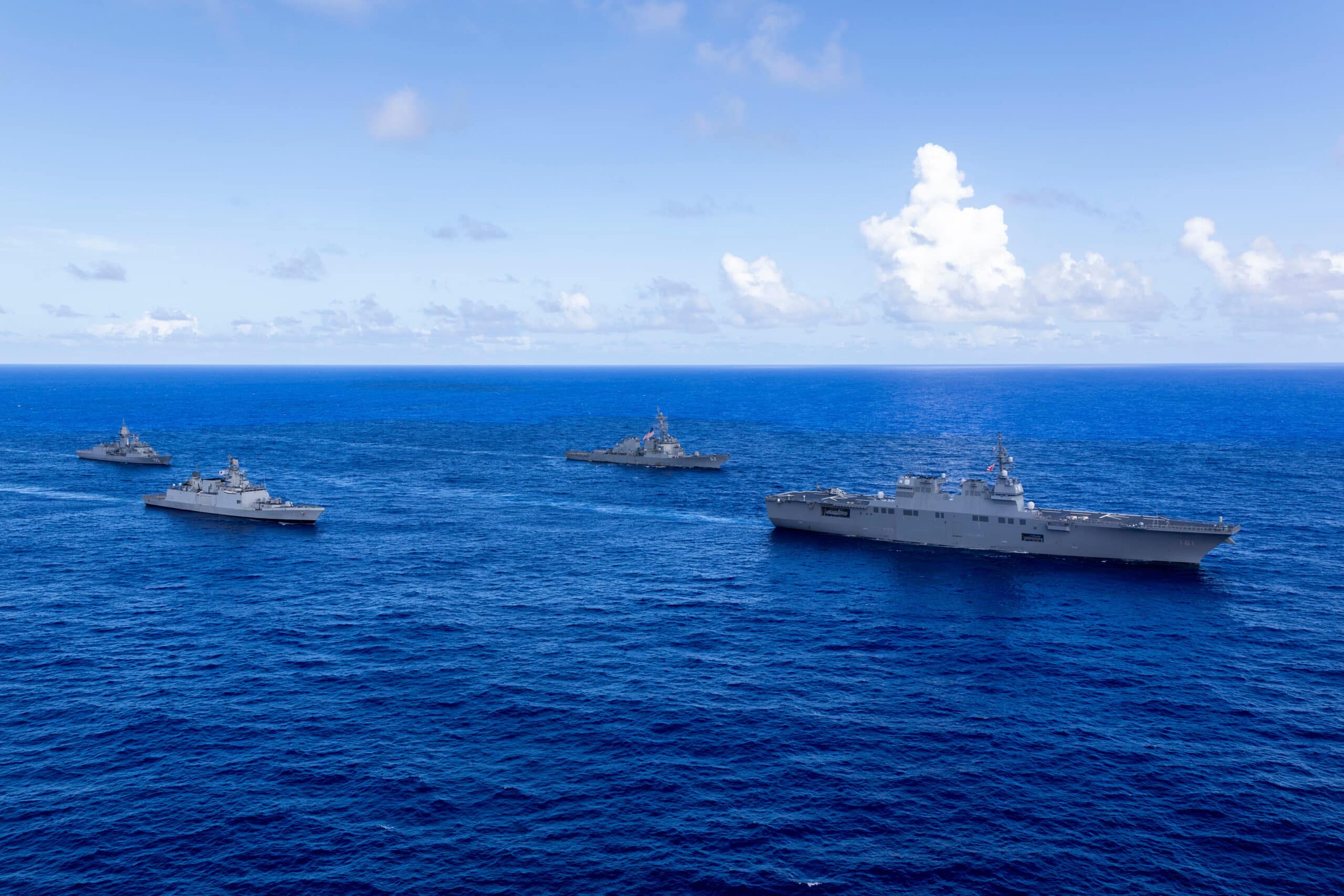
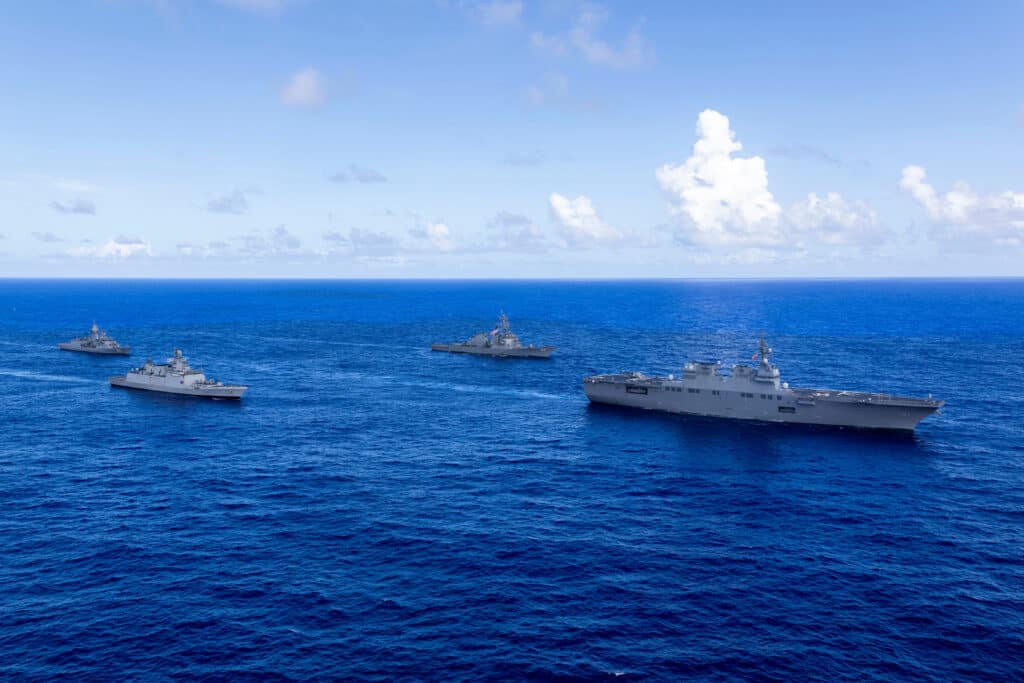
In a clear signal of growing strategic coordination in the Indo-Pacific region, the four-nation United States Indo‑Pacific Command (US INDOPACOM)-led exercise Exercise Malabar 2025 took place 10–18 November 2025 around the island of Guam, involving the naval and air forces of the Australian Defence Force (Australia), Indian Navy (India), Japan Maritime Self‑Defense Force (Japan) and the United States Navy (US). cpf.navy.mil
The exercise featured surface warships, maritime patrol aircraft, submarine detection drills, and joint logistics operations. Notably, the HMAS Ballarat (Anzac-class frigate) of Australia, India’s INS Sahyadri (Shivalik-class frigate), Japan’s JS Hyūga (Helicopter Destroyer) and the U.S. destroyer USS Fitzgerald operated in formation, underscoring the deepening interoperability among the Quad partners. cpf.navy.mil
Strategic Context
The Indo-Pacific region has become the central theatre of maritime competition in this decade. China’s expanding naval reach, missile capabilities, submarine fleet and influence in key sea-lanes have prompted regional actors and external powers to recalibrate their maritime posture. In this light, the Malabar exercise serves multiple strategic functions:
Deterrence & signalling — By operating around Guam, a U.S. territory and critical strategic node, the four partners collectively signal resolve to maintain freedom of navigation, assure regional allies and constrain adversarial power projection.
Interoperability & network building — The integration of disparate naval and air forces from four different strategic cultures enhances joint readiness, logistics operations and command-and-control frameworks. Such capacity is crucial for rapid responses in distributed maritime environments.
Forward posture and logistics webs — The selection of Guam emphasises the importance of forward infrastructure, supply chains and basing options in the Indo-Pacific. As maritime domains become more contested, the ability to sustain and support operations far from home ports becomes a strategic differentiator.
Indo-Pacific strategic alignment — The participation of Australia, India and Japan alongside the U.S. further cements the Quad construct as a multidimensional security architecture—not just a dialogue forum but a functional maritime cooperation mechanism.
Implications for Regional Order
The conduct of Malabar 2025 around Guam signals the following shifts:
Additional regional states may increasingly seek to participate or align with similar exercises, broadening the architecture of maritime collaboration beyond bilateral ties.
The logistics and sustainment patterns required for such deployments point to infrastructural development (ports, air bases, undersea cables, supply hubs) becoming strategic nodes themselves.
For China and other regional powers, such exercises complicate potential calculations of coercion, blockade or rapid escalation, because adversaries now face a more integrated, multi-national response capability.
Considerations & Challenges
Despite the clear strategic value, several constraints remain:
Political and strategic diversity among partners may hamper fully integrated command structures or shared rules of engagement.
Sustaining operational tempo across vast ocean spaces is resource-intensive; maintaining funding, training and readiness will be crucial.
While the Quad now functions with stronger naval cooperation, the broader question remains: will it evolve into a formal alliance or remain a flexible partnership?
Non-traditional threats—cyber, space, undersea sabotage—also require maritime cooperation to adapt. Exercises like Malabar must increasingly incorporate these domains to stay relevant.
Conclusion
Exercise Malabar 2025 exemplifies how the Indo-Pacific region’s security architecture is evolving: from bilateral alliances anchored in the Cold War to multilateral, forward-deployed, networked partnerships built around maritime power, logistics, and interoperability. For researchers focused on Indo-Pacific strategy, this development underscores that the seas—once the domain of state navies in isolation—are now the locus of alliance-based, multi-domain deterrence. The direction of regional order will be shaped as much by logistics and cooperation as by sheer military hardware.