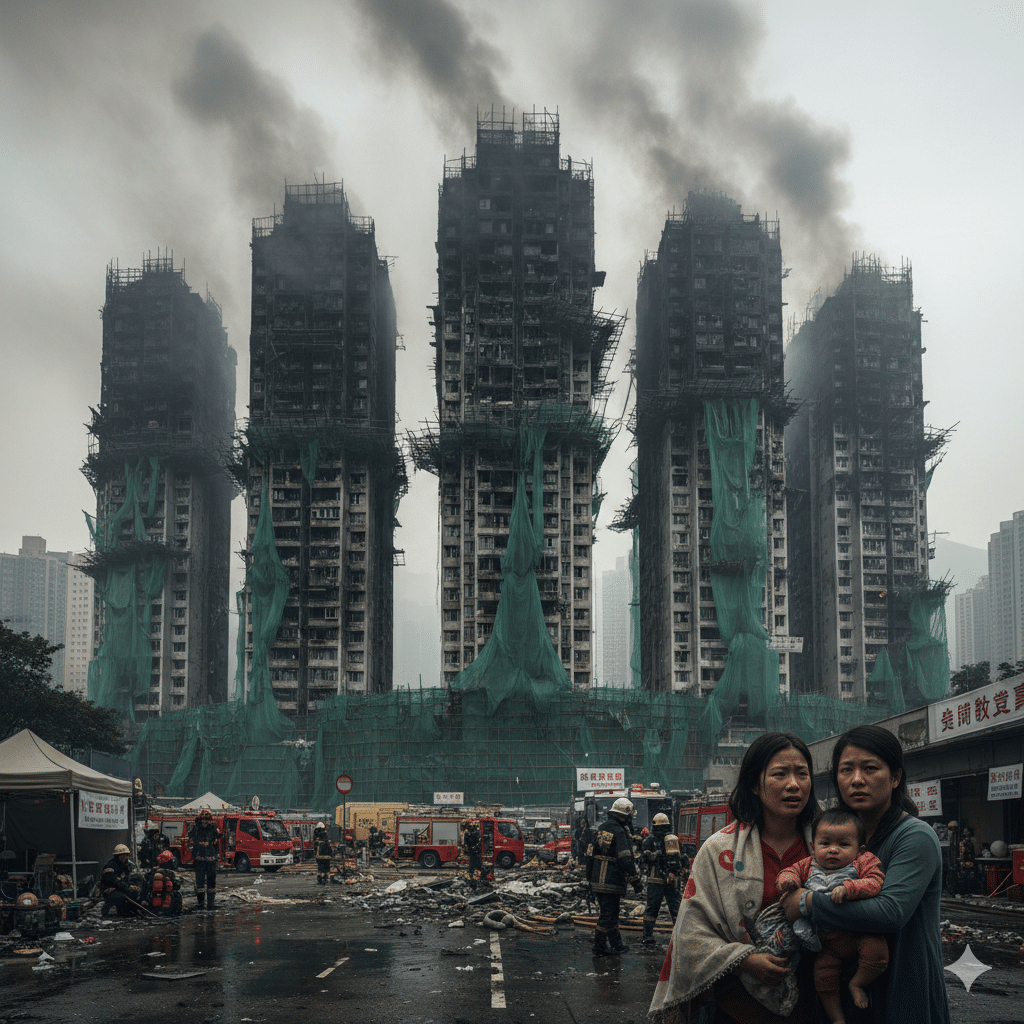
The deadly fire at Hong Kong’s Wang Fuk Court is not merely a public safety tragedy, but a critical stress test of the city’s urban resilience framework and a stark illustration of regulatory arbitrage. Our analysis, based on the disaster timeline, reveals a systemic breakdown rooted in the over-reliance on high-risk temporary materials (bamboo scaffolding, flammable netting) and corporate strategies prioritizing cost over safety compliance. This brief analyzes the structural vulnerabilities exposed and provides strategic projections for policy trajectories over the next three to five years.
I. Defining the Crisis: A Nexus of Structural Vulnerabilities
The high fatality rate of the Wang Fuk Court fire resulted from the convergence of multiple structural risks:
Infrastructure Flammability: During large-scale maintenance, the entire complex was encased in highly flammable materials (bamboo scaffolding, polystyrene, plastic netting). These materials served not only as fuel but as a strategic conduit for the rapid vertical and horizontal spread of the fire, bypassing internal fire compartmentalization.
Regulatory Enforcement Failure: Official records indicate that the Labour Department issued written reminders shortly before the fire, yet failed to ensure contractors implemented effective site-specific risk mitigation. This exposed a fatal disconnect between regulatory action and actual compliance.
Magnified Social Vulnerability: The disaster disproportionately impacted structurally vulnerable groups, particularly Foreign Domestic Helpers (FDHs). Their cramped living conditions and non-citizen status meant they were the least protected by social safety nets in the immediate aftermath of the crisis.
II. Policy Failure Framework: The Role of Regulatory Arbitrage
This fire should be framed as the outcome of regulatory arbitrage within the construction sector—where contractors exploited ambiguities in the law (e.g., loose standards for temporary materials) to choose the highest-risk, lowest-cost options for profit maximization.
Externalization of Risk: The use of cheap, highly flammable scaffolding materials externalized the risk of catastrophic failure from the contractors and building owners onto the residents and the general public.
High Accountability Threshold: Although authorities swiftly arrested multiple corporate directors and project managers on suspicion of manslaughter and gross negligence, the timeline demonstrates that the legal accountability mechanism is only effectively triggered when the loss of life reaches an extreme scale. The low-frequency, high-impact risks of everyday construction had been systematically ignored.
III. Cross-Jurisdictional Governance and Beijing’s Role
Under the new political paradigm of “Patriots Governing Hong Kong,” this disaster also serves as a public examination of the HKSAR Government’s governing capacity, highlighting the central government’s involvement:
Central Government Directives: China’s President Xi Jinping promptly issued a directive for “all-out efforts” to minimize casualties and losses. This elevated the crisis response to the highest political level, emphasizing Beijing’s commitment to Hong Kong’s stability and demanding thorough and efficient accountability and rescue efforts from the HKSAR government.
Resource Integration and Standardization: While the HKSAR government handled the immediate firefighting, the Central Government and Guangdong authorities offered medical supplies and technical aid. Crucially, the HKSAR has requested Mainland assistance to enhance the testing capacity for fire-retardant materials, a strategic signal to align local technical analysis with Mainland standards.
External Pressure on Governance: Beijing has framed the fire as a failure of the local government’s performance, rather than a failure of its overarching policy towards Hong Kong. This places significant pressure on the HKSAR to deliver quantifiable and substantive reforms swiftly, with Beijing likely to more closely monitor performance in urban safety and grassroots governance moving forward.
IV. Strategic Projections: Mandatory Policy Shifts (2026-2030)
Given the severity of this tragedy and the public scrutiny, we project several irreversible policy and market structural changes in Hong Kong’s governance and relevant industries over the next 3-5 years:
Construction Standards Paradigm Shift (Construction & Fire Safety): The government will initiate a phased, mandatory phase-out of traditional bamboo scaffolding and highly flammable netting in high-density and high-rise maintenance projects. This will be replaced by non-combustible or fire-resistant temporary external systems.
Heightened Corporate Governance and Criminal Liability (Governance & Accountability): Legislation is expected to be strengthened to lower the threshold for prosecuting corporate directors and senior managers for manslaughter or gross negligence, forcing companies to view safety compliance as a core governance imperative.
Labor Policy and Social Resilience Linkage (Social Resilience & Labour Policy): The disaster will force a renewed policy debate on the mandatory live-in rule for FDHs. Policymakers may be compelled to establish minimum safety and living space standards, integrating the housing security of this vital labor force into the overall urban resilience plan.
V. Conclusion: From Crisis Management to Strategic Design
The lesson from Wang Fuk Court is clear: when a city prioritizes short-term economic expediency over systemic safety, its vulnerabilities are amplified. Hong Kong’s policymakers must move beyond mere crisis management and focus on strategic risk design. Only through robust legislation, a transformation of the accountability culture, and the integration of the most vulnerable citizens’ safety into core urban development can the city truly rebuild the credible urban resilience required of a global financial center.